
The Universe is 92 billion light-years across but only 13.8 billion years old. Does that mean it is expanding faster than light — and wouldn't that violate Einstein's theory of relativity?
Before diving deeper into it, let's first understand what “the universe is expanding” means. It means that the galaxies, which are the building blocks of the universe, are constantly growing apart with time as the space between them pushes them farther.
Around 13.8 billion years ago, the event we call the Big Bang occurred not as an explosion, but as the rapid expansion of space itself. The universe expanded faster than the speed of light for a fraction of a second, a period called cosmic inflation. This inflation was believed to be driven by the repulsive gravity of an unusual state of the vacuum. Because of this rapid early inflation, the Universe is far larger than its age in years might suggest.
A rubber sheet and some coins
To better understand inflation, consider a flat rubber sheet with a grid drawn on it and tiny coins placed at the intersections of the grid, representing the universe and galaxies respectively. When you stretch the rubber sheet evenly in all directions, the grid lines expand, and the coins get farther apart. This does not mean the coins are moving further away, but that the sheet is expanding, causing the coins to move.
Now, let's talk about Einstein. According to him, the speed of light is the cosmic speed limit. In other words, nothing with mass can move faster than light. But this is only true in Einstein's special theory of relativity of 1905. A decade later, he improved and extended this theory to the general theory of relativity (1915), which describes how mass and energy shape spacetime. This fabric of spacetime expands, stretching the distance between galaxies. Since spacetime isn't a material object, it's not bound by the speed of light and can expand at any rate.
It was never a matter of something racing through space, but of space itself racing to become more space.
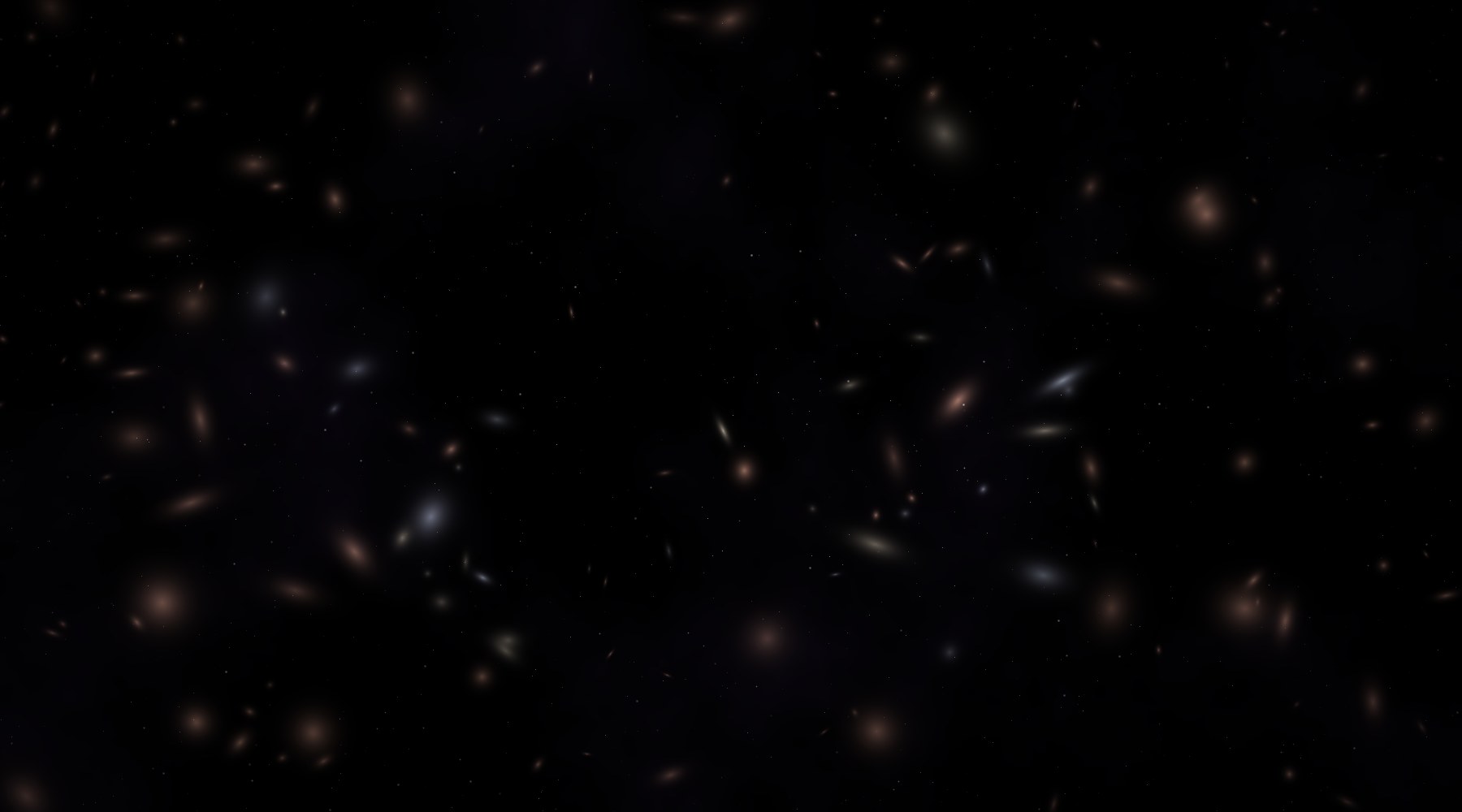
Cosmic inflation ended long ago, but the Universe is expanding even now. Therefore, if we observe a galaxy, we are actually observing the light it emitted millions or billions of years ago. Because the light takes time to travel, it is like looking into the past. Another interesting thing is that even as that light moves towards us, the distance between the galaxy and us continues to increase. This further stretches the wavelength of the light, making it look a little red-ish. This phenomenon is called the cosmological redshift, and it's one of the strongest pieces of evidence that the Universe is expanding.
Which leads to a rather humbling thought. Every night, when we look up, we are not looking at the Universe as it is but at thousands of old photographs, arriving one by one, from places that no longer exist where we see them. The star may be gone. The galaxy may have drifted somewhere else entirely. And by the time its light finally reaches your eye tonight, on this ordinary evening, the distance it had to cross has already grown a little more.
Published by Infinity Space Club · UPES, Dehradun