

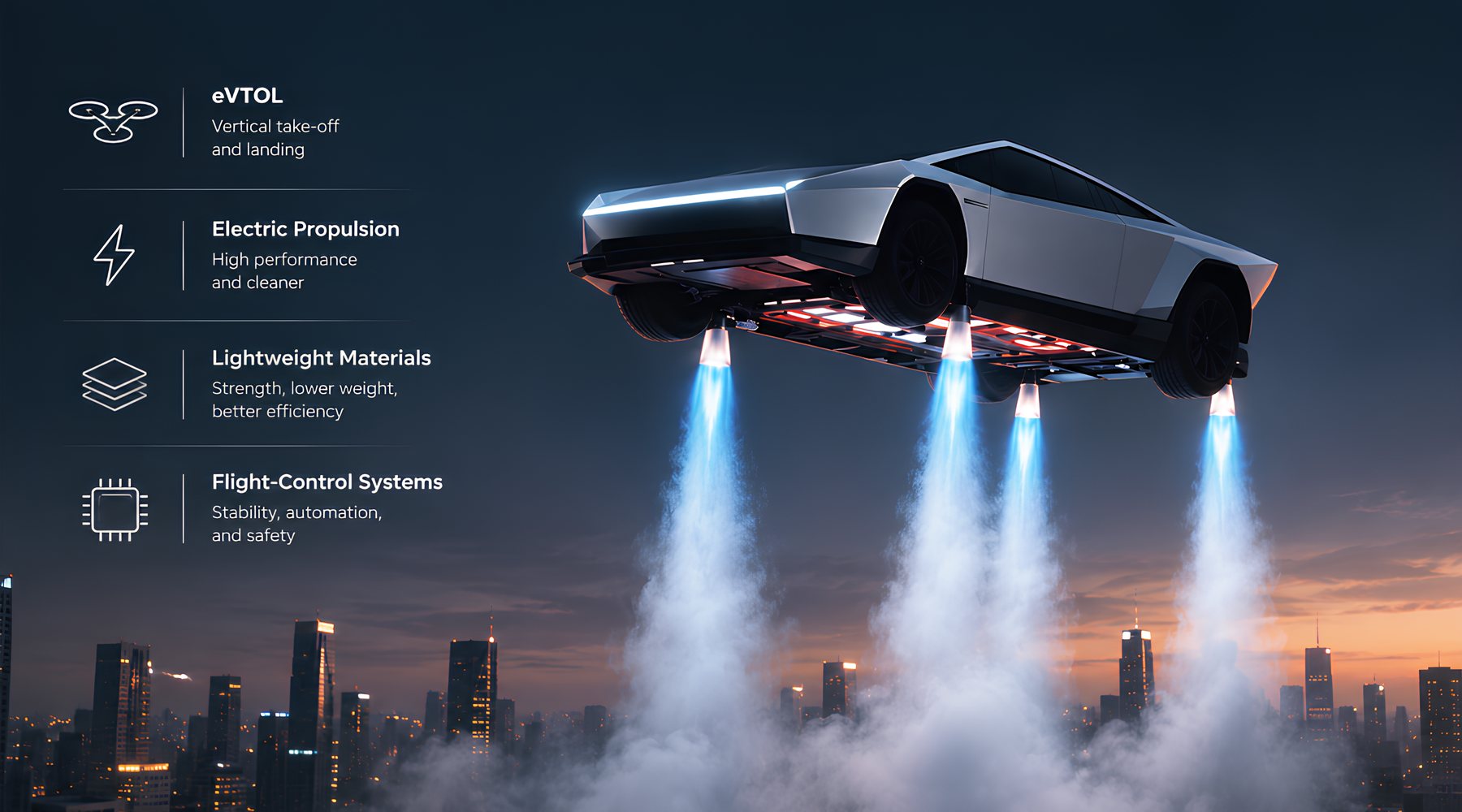
Flying cars have long been associated with science fiction, but engineers are working to make this idea possible. Advances in electric propulsion, lightweight materials, and flight-control systems are bringing new kinds of aircraft closer to everyday use. The bigger question is not simply whether we can fly between buildings, but whether we can do it safely, affordably, and efficiently.
No runway needed
Many of the vehicles being developed for this future use eVTOL technology, short for electric vertical take-off and landing. Instead of needing a long runway, they use electrically powered rotors or propellers to lift off and land vertically. In some ways, they combine the convenience people associate with cars and the flight systems of aircraft. But the engineering challenge is much greater than putting wings on a car: designers must carefully balance weight, aerodynamics, stability, propulsion, and energy use.
A car that hops
A recent innovation has taken the idea of a flying car in a completely different direction. In October 2026, Tesla demonstrated its new Roadster with SpaceX-derived technology, showing a prototype capable of becoming airborne, controlling its orientation in the air, and landing using a system of cold-gas thrusters. The vehicle demonstrated several capabilities, including short-hop flight, fan-generated suction for increased downforce, and the ability to jump or flip over obstacles. The vehicle also achieved 60 mph acceleration in less than one second.
Where it could help
If these aircraft become practical, they could be useful in specific situations. Electric air taxis might connect airports with city centers or link places where road journeys are slow. Smaller aircraft could also support emergency response, medical transport, or the delivery of supplies to areas which are difficult to reach.
However, the ability to fly above traffic does not necessarily make transportation easier. Several practical challenges must be considered, including sufficient battery capacity and energy reserves, strict safety requirements, and the need for suitable landing infrastructure. In addition, factors such as noise, affordability, and the regulation of low-altitude air traffic will be important in determining how effectively flying cars can be integrated into everyday transportation.
Flying cars would not replace conventional cars anytime soon. The question worth asking is whether this technology makes our lives better. Their real value will depend on whether engineers can make them safe, quiet, affordable, and useful beyond a handful of special routes.
The future of transport may not be a choice between roads and skies; it may be about finding the right technology for every journey.
 Next blog · Cosmology · 4 min read